

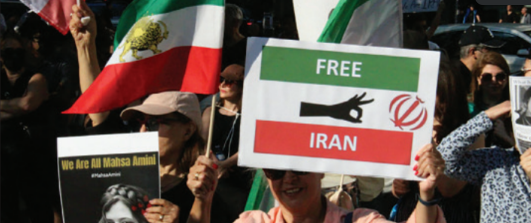
The people of Iran have been suffering for so long, and their pain needs to end. I implore you to educate yourself to have a greater understanding of Iran’s past and present.
Headlines about Iran often reduce a complex country to brief flashes of conflict and politics, but the reality is far more complicated, shaped by uncertainty, resilience and decades of suffering.
Iran’s current crisis didn’t appear overnight–it was built over decades of political decisions that prioritized control over freedom. In the late 70’s Iranians had been in opposition to the monarchy because of increasing wealth gaps, westernization and corruption. Ruhollah Khomeini, a Shia Islam scholar, had been previously exiled from Iran due to his protesting against the monarchy, and subsequently moved to Iraq. When Khomeini returned to Iran from exile, he led a successful movement to replace the Persian monarchy with an Islamic Republic in 1979. This fundamentally restructured the country’s political system.
Initially, the Iranian people were eager for a new government. They wanted democracy and representation. However, the new system mixed politics with religious leadership and created new problems. Now, Shia Muslim Clercs hold the most power, and integrate excessive and violent Sharia (Muslim extremist) law. Incorporating these two together converted private beliefs into public guidelines—ones that many Iranians do not identify with.
I am a second generation Iranian. My mom was born and raised in Iran until about 16 years old until she left due to the revolution. The current state of the country has weighed on me heavily. My family members, traditions and culture reside there. To see my people struggle for essential human rights is heartbreaking. I have had extreme difficulty contacting my family in Iran because their internet has been shut off for over two months.
In 2022, a 23-year-old woman named Mahsa Amini was wearing her hijab “too loose” for strict Islamic dress code regulations. She was beaten by the Islamic Revolutionary Guard Corps (IRGC), and died in a hospital. Her death is what started the nationwide “Women, Life, Freedom” movement. This movement eventually formed into a broader rebellion against the cleric rule.
Foreign forces have amplified the country’s political unrest, not helped the people.
In 2018, the United States withdrew from the Joint Comprehensive Plan of Action, a plan that was critical in keeping Iran’s economy thriving by relieving sanctions. Inflation has extensively declined the value of Iranian currency. As a result, many families can’t even afford basic necessities. Over 40% of Iran’s population is living below the poverty line according to the National Council of Resistance of Iran.
The severe drop in currency value led to rising numbers of protests starting January 2026. In response the government has responded with violent repression. Iranians were arrested, beaten and murdered unlawfully by the IRGC. Families searched rows and rows of unidentified body bags to find their loved ones in the aftermath of the protests. It is estimated that over 30,000 civilians were killed by the IRGC according to Al Jazeera. The heart of the problem lies within the country’s government. These protests for basic human rights highlight a vicious cycle. Citizens push for their rights, authorities respond with force, and public opposition dies down.
At the same time, rising military tensions and conflict have intensified the crisis, connecting Iran’s internal struggle to global instability. The Strait of Hormuz in Iran helps transport about 20% of the world’s oil. Military standoffs, ship seizures and blockades have disrupted the route, leading to worldwide economic pressure.
It’s important to remember that Iran is a country with real people who have been fighting for their rights continuously despite oppression. The Islamic Regime does not represent the voices of Iran, it silences them. The people shouldn’t be defined by its government and conflict. Iran is home to so much beauty and resilience woven into its culture. Iranians, like my family, carry their identity with strength and pride. This is the Iran I know, and a free Iran is the one the whole world deserves to see.