

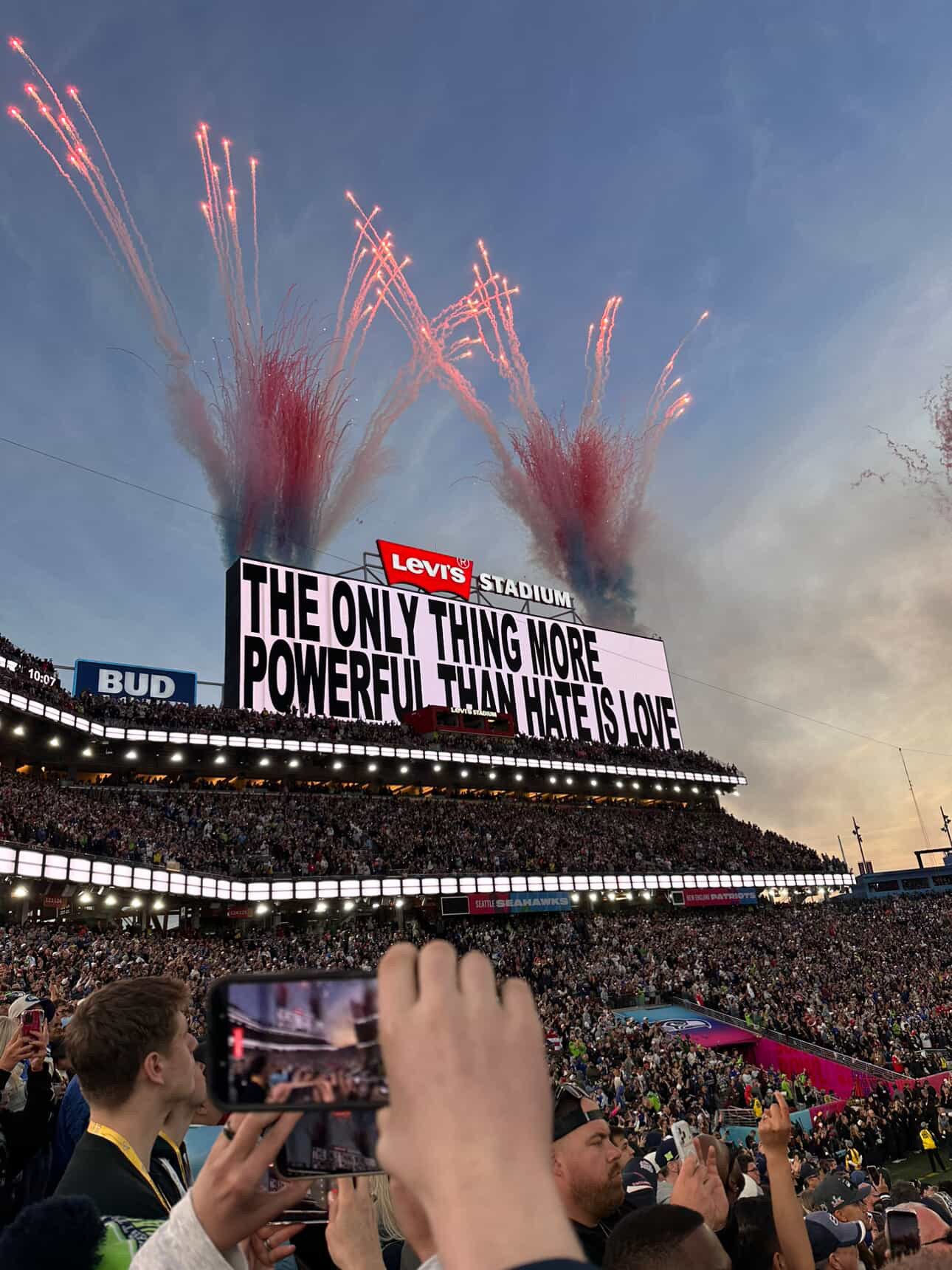
This year, singer and songwriter Benito Antonio Martínez Ocasio, Bad Bunny, made history as the first artist to perform a Super Bowl halftime set solely in Spanish. His 13-minute show centered around unity and love, spreading a powerful message to the approximately 135 million viewers around the world.
When the announcement was made that Bad Bunny would perform at the Super Bowl, there were displays of celebration, such as rapper Shawn Carter, JAY-Z, who said in an article by the National Football League (NFL) that “what Benito has done and continues to do for Puerto Rico is truly inspiring,” along with Oliver Schusser, Apple’s Vice President of Music, saying that this “show will be unforgettable.” But there were also public displays of frustration and hate.
President Donald Trump called Bad Bunny a ridiculous choice on social media and encouraged people to watch an alternative halftime show put on by Turning Point USA. He additionally claimed he has never heard of Bad Bunny and would not be attending the Super Bowl.
Spanish teacher Marisol Kreuzer believes Bad Bunny’s performance celebrated diversity and promoted cultural visibility.
“It’s really a great statement to make about diversity. Being aware of bilingualism and recognizing that there are people in this country who are part of this community. The performance was really a statement that I can say that [the Latino community] is here to stay,” she said.
Spanish teacher Trevor Todd said the show brought his family hope.
“I got to watch it with my daughter. What we were talking about afterwards was the celebration of joy and love and community, especially against the backdrop of the political hate speech of our times. The juxtaposition of those two things was the political act for us,” Todd said.
He also says the halftime show sent a positive message about culture, specifically culture from Latin America.
“It caught people off guard. [It made people think], ‘Oh, it’s a typical dance party, like a dance video.’ And no, it’s not. It’s about culture and community. [The choice of] love versus [the current climate of] hate,” Todd said.
He notes how the show’s messages about unity and celebration of cultures derive from specific details, such as Bad Bunny dancing on a sparking telephone pole while singing his song “El Apagón,” which translates to “The Blackout.” This represented Puerto Rico’s ongoing power crisis.
About halfway through his performance, Bad Bunny brought out singer-songwriter Lady Gaga, who performed a salsa version of her song “Die with a Smile.”
Spanish teacher Erik Velasquez believes Lady Gaga amplified Bad Bunny’s message.
“She could be in the Super Bowl just by herself, but she’s not there to be the main star. She is a white person who can support those minorities that need that lift, and she’s there not to amplify herself. She’s there to amplify what he’s doing,” Velasquez said.
Senior Isabella Mercado noted that Bad Bunny celebrated unity instead of hate.
“He’s opposing polarization, which is very prevalent in our country right now,” Mercado said.
Kreuzer agreed.
“I think that we forget kindness, and we forget love, and we forget that everybody is another human that is carrying a lot on their shoulders,” Kreuzer said.
The show concluded with a powerful message: the JumboTron displayed what Bad Bunny said during his Grammy acceptance speech the previous week, “the only thing more powerful than hate is love.” As flags from Latin America filled the field, Bad Bunny’s final statement highlighted that American culture extends far beyond the borders of the United States.