
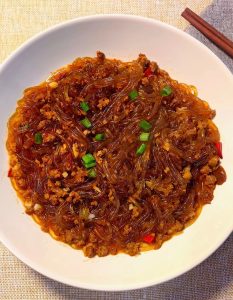
Courtesy of THE FLOURED CAMERA
Ants Climbing a Tree (蚂蚁上树) by Allison Hu, Anna Toll and Nova Wu
Background
Ants Climbing a Tree is a popular Sichuan Chinese dish made with glass noodles and ground pork. The name originates from the noodles resembling tree branches and the small pieces of pork looking like ants climbing on the tree. The dish is savory, slightly spicy and very common in Chinese home cooking.
Ingredients
- 1 bundle glass noodles (vermicelli)
- 1/2 pound ground pork
- 2 cloves garlic, minced
- 1 green onion, chopped
- 1 tablespoon soy sauce
- 1 tablespoon chili bean sauce (optional)
- 1 teaspoon sugar
- 1 cup water or chicken broth
- 1 tablespoon cooking oil
Instructions
- Soak the glass noodles in warm water for about 10 minutes until soft.
- Heat oil in a pan.
- Add garlic to the pan and cook for 30 seconds.
- Add ground pork and cook until brown.
- Add in the soy sauce, sugar and chili bean sauce.
- Pour in either water or broth.
- Add the softened noodles and mix well.
- Cook until the noodles absorb the sauce.
- Add green onions on top and serve hot.
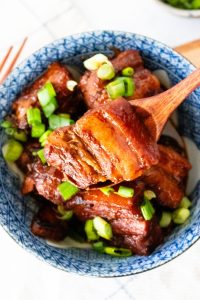
Courtesy of CHINA SICHUAN FOOD
Red braised pork belly (红烧肉) by Cindy Wu, Yueyue Wang and Suraya Desai
Background
Red-braised pork belly is a traditional Chinese dish that is especially popular in many parts of China, including Shanghai and Hunan. It is often served during family meals and on special occasions. The dish is made with layers of pork belly slowly cooked in soy sauce and wine until tender and flavorful. The dish is savory-sweet and looks glossy and reddish-brown from the sauce.
Ingredients
- 800g pork belly
- Rock sugar (a few pieces)
- 1/2 tbs cooking wine
- 2 tbsp dark soy sauce
- 2 tbsp soy sauce
- 1 star anise
- 1 cinnamon stick
- 2 bay leaves
- 1 scallion stalk
- 1 ginger
- Salt (to taste)
Instructions
- Cut the pork belly into approximately 2 cm square chunks and wash and blanch in boiling water.
- After blanching, rinse and drain the pork belly.
- Heat oil in a pan and stir-fry the rock sugar until small bubbles appear.
- Add the pork belly and stir-fry until it is browned.
- Add ginger, star anise, and cinnamon and stir-fry until fragrant.
- Add appropriate amounts of light soy sauce, cooking wine and salt, stir-fry evenly, then cover with water.
- Bring to a boil over high heat for about 15 minutes, then reduce to a simmer over low heat for about 30 minutes. Finally, reduce the sauce over high heat.
- Garnish with chopped green onions and sesame seeds.
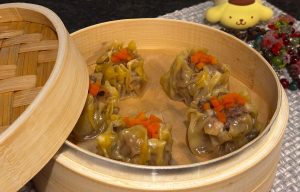
meals and on special occasions.
Siu mai (烧麦) by Eva Gao, Nikki Lang and Cheryl Hung
Background
Siu Mai originated in Yuan Dynasty tea houses. It is an open-top steamed dumpling with thin dough, wrapped around a savory filling. Known for its flower-bud shape, it has become a staple of Cantonese Dim Sum and Northern Chinese breakfast.
Ingredients
- 3 shiitake mushrooms (re-hydrate in boiling water if dried)
- 350g/13oz ground pork
- 2 tsp sugar
- 1 tsp soy sauce
- 1.5 tsp Chinese cooking wine (sub: Shaoxing wine, mirin or dry sherry)
- 150g/5oz shrimp
- Approximately 20 Siu Mai wrappers (sub: wonton wrappers)
- Topping: fish roe or carrots
Instructions
- In a bowl, mix the ground pork with the condiments using a spoon or your hands. Continue until the mixture reaches a pasty consistency.
- Cube the shiitake mushrooms and shrimp. Mix them in, ensuring the shrimp is not crushed in the process.
- Line your steamer (bamboo or stove steamer) with baking paper with poked holes in it.
- Use a pan large enough to hold your steamer, and fill it up with water just before it floods your steamer. Bring to a boil.
- While the water is heating up, begin wrapping. Form an “O” with your index and thumb, then place a wrapper over it.
- Fill your wrapper with one heaping tablespoon of filling, and push it down (watching a video helps!)
- If you’re using carrots as the topping (make sure they’re cut into little cubes), add them on before steaming. If you’re using fish roe, add it after.
- Place your Siu Mai on the steamer, pressing it down slightly to ensure a flat, balanced bottom.
- Steam your Siu Mai for 8-10 minutes.
- Serve immediately after cooking, with soy sauce or vinegar.