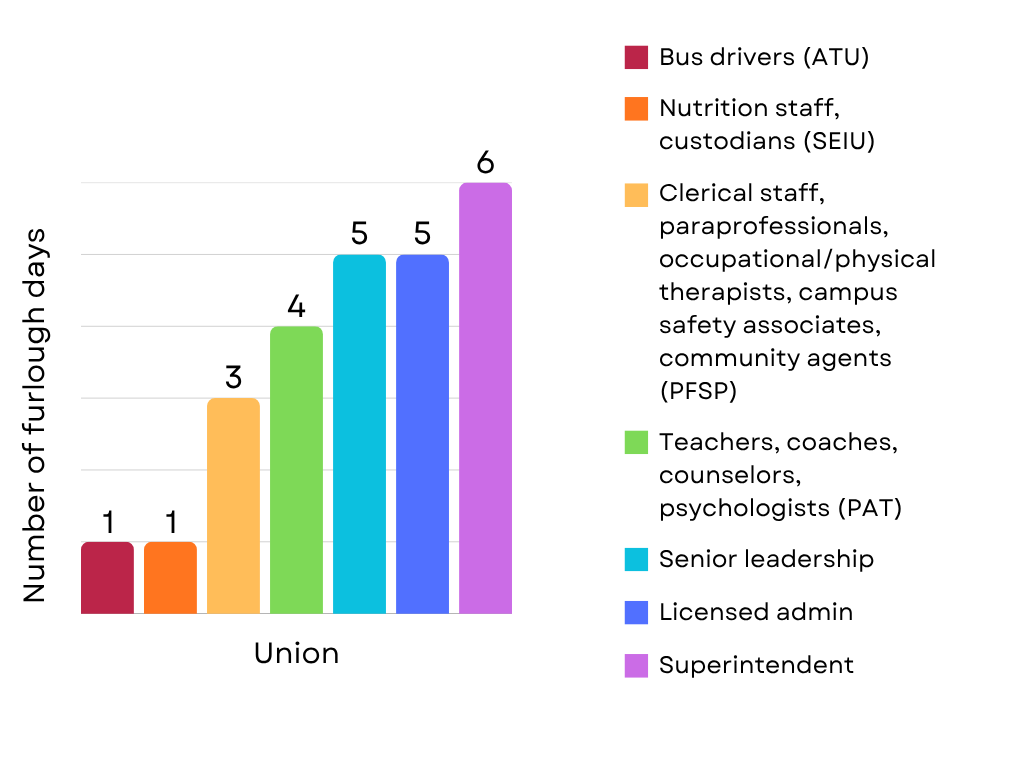
On March 22, Portland Public Schools (PPS) and the Portland Association of Teachers (PAT) agreed to furlough four days off the school year to help close the $50 million budget deficit. A furlough day is a mandatory, unpaid day off from work. PPS and the PAT agreed to furlough May 1, May 25, and June 9 and 10. The days include previously paid holidays such as Memorial Day, as well as normal school days.
“It’s an overall reduction in the number of teaching days that a teacher has in a year,” said social studies teacher and PAT bargaining team member Rion Roberts.
The decision to furlough days was not reached easily. After PPS found a budget shortfall in February, the PAT bargaining team met with PPS multiple times to request more information. Eventually, they settled on two possible options to close the budget gap. The teachers in the PAT voted on whether to furlough or to fire educators halfway through the school year.
“We have to accept a certain number of furloughs… so that we don’t lose 200 of our colleagues this calendar year in addition to the 200-300 they’re planning for next year for the budget cuts,” said PAT president Angela Bonilla.
Four furloughed days for teachers means losing approximately 2% of their salary, which some educators cannot afford. Teachers also say the furlough days will significantly impact their planning time and classroom instruction.
“[The furlough days] made it such that I’ve had to reduce a lot of my lessons into just delivering information… there’s always the fear [of] loss of comprehension,” said Roberts.
Social studies teacher Alex Stegner agreed that the furlough days made lesson planning harder.
“It’s impossible already to teach all the things that we’re asked to teach in the time that we’re given,” said Stegner. “These furlough days are just going to make… an impossible job, even more impossible.”
Furlough days will not only affect teachers, but also other staff.
“Nutrition services and custodians… bus drivers, education assistants, [paraeducators], secretaries would have to take furloughs,” said Bonilla. “But what we said was [PPS] our district leadership should take more [furloughs]. They’re making way more money than the rest of us.”
PPS did not respond to a request for an interview.
It is not just the district that influences the budget. Stegner said there is “a lack of leadership in all kinds of areas, starting with our governor and our state legislators.”
A month after PPS and PAT reached an agreement on furloughs, Governor Kotek signed an executive order preventing districts from reducing instructional time to close budget gaps. PPS will have to restore their number of school days to their 2024-25 levels by the 2027-28 school year.
“Instructional time is critical for Oregon’s students… we cannot expect better student outcomes if we continue to give our students less time to learn,” said Kotek in a press conference.
Both PAT and PPS have previously suggested tapping into the Education Stability Fund, a reserve of approximately $1 billion which could be used in times of emergency to aid districts with meeting budget constraints. Kotek has not released the fund and schools are facing the consequences of the budget gap.