
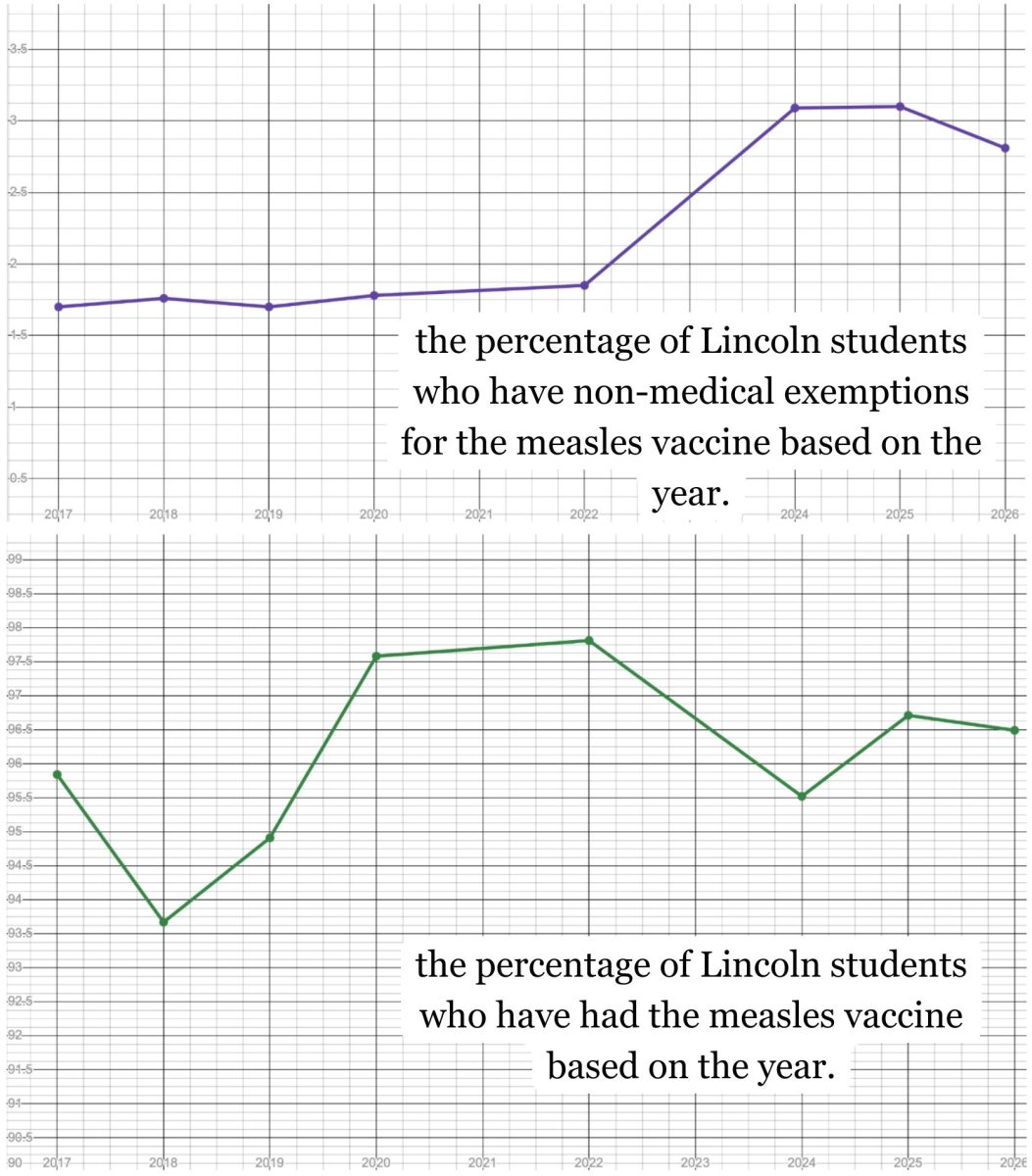
Over the past five years, the percentage of Lincoln students who opt out of the measles vaccine due to non-medical exemptions has increased by 0.96%, tracking with national trends identified by studies conducted by the Centers for Disease Control (CDC).
In 2026, thus far, there have been 21 cases of measles reported in Oregon. This comes as a surprise, given that there was only a single case of measles in 2025, and in 2024, no cases of measles were reported. These cases first emerged in Linn County, but have since spread into East Portland.
Measles is a highly contagious viral infection that can be spread through coughing and sneezing. Although most recover quickly, measles can be fatal for children under five, as well as people with compromised immune systems.
The Measles, Mumps and Rubella (MMR) vaccine not only protects the recipient from measles, but also their community, through the concept of herd immunity, biology teacher Maggie Raczek explains.
“If we can get a significant portion of the community [to be] vaccinated against a particular disease or have already contracted it [and developed immunity]… Then we can protect those people in our community who are more vulnerable and may not be able to actually get a vaccine themselves,” said Raczek. “[Those who can’t get vaccinated are] going to be less likely to come into contact with it and less likely to get it.”
To achieve herd immunity, 95% of the community must be vaccinated against measles, which Lincoln maintains with 96.5% of students vaccinated.
Sophomore Nora Christy identifies misinformation about vaccines as an underlying cause of the measles outbreak.
“People think that vaccines will cause autism,” said Christy. “But if anything, any effect that you have from a vaccine is going to be much better than the effect that you would have from actually getting measles.”
The best precaution against disease is to stay informed about the spread of measles, which can be done through the state of Oregon’s page on measles.
Lincoln nurse Mary Johnson emphasizes the importance of basic hygiene.
“Hand washing is extremely important,” said Johnson. “If somebody knows that they’ve got a virus that could be communicable, [they should wear a] mask. Using all of those precautions helps decrease spread, just like any other [disease].”