Portland Art Museum’s “Yoshida Chizuko” exhibition is the first major retrospective of the artist, a pioneer in painting and printmaking in Japan. The exhibit spans Chizuko’s entire six-decade career and includes her avant-garde oil paintings from the post-World War II period and experiments in monotyping, woodblock prints, lithographs and other mixed-media pieces.
Chizuko Yoshida (1924-2017) was born to an art collector and would later marry into the art-renowned Yoshida family. As a child, Yoshida pursued music and dance, and her paintings would later reflect the rhythm and elegance of that passion.
The exhibit traces Yoshida’s career and features many works not previously displayed. Over the course of her life, Yoshida’s style evolved from soulful abstraction to bright photo-etchings to woodblock prints, which would ultimately define her career. Almost like imprints of the past, her blind embossing in “Ao no fūkei (Landscape in Blue)” balances tenderness and contemplation.
What stood out to me about Yoshida’s work was her subtle engagement with the natural world and the emotion and thought provoked across her works. She perfectly captures the rhythm and cadence of rain in her piece “Rain,” adding rounded shapes to the ends of her otherwise straight raindrop strokes, so they look like musical notes. Paired works like “Autumn Wind” and “Cool Breeze” reveal her attention to the change of seasons, depicting a lavender field shifting from warm tones to cool blues as time passes from autumn to winter.
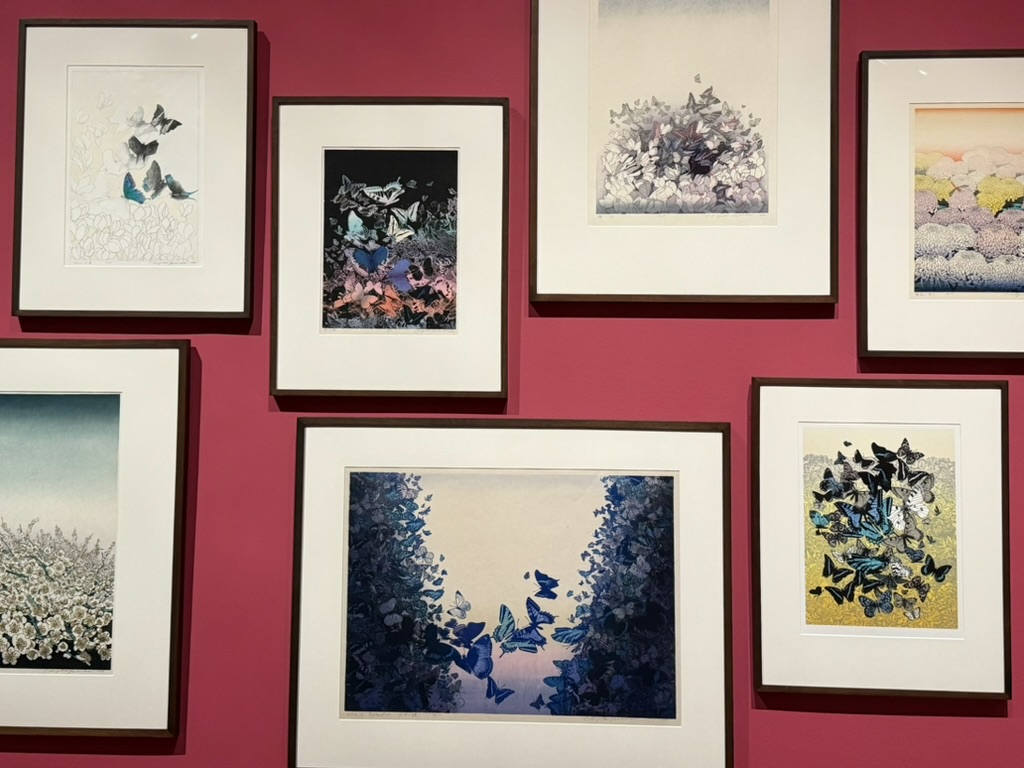
In the late 1970s and through the 1980s, Yoshida often depicted butterflies and other natural elements. One of her most evocative pieces was “Oboroyo.” The word itself refers to a hazy, soft, moonlit night. The painting is a dreamlike depiction of butterflies and blossoms in a quiet but bright atmosphere and embodies Yoshida’s signature qualities of lyricism and a subtle sense of movement.